



GCA StoreScan
GCA StoreScan: seeing your garden centre the way your customers and your competitors do
Every garden centre owner knows their own store better than anyone else. That is exactly the problem.
After years of walking the same aisles, you stop seeing them. The entrance feels normal because it has always looked that way. The indoor plant department feels strong because it always has been. The checkout area feels fine because nobody complains. Meanwhile, three kilometres down the road, a competitor has quietly rebuilt their outdoor green section and is taking spend that used to be yours.
StoreScan is how we replace that internal picture with an external one: measured, scored, and set side by side with the stores you actually compete against.
What StoreScan is
StoreScan is a structured assessment of a garden centre, carried out from the outside in. We visit as a customer would, walk the full journey, and score what we find against a fixed framework. We then do the same for a set of comparison stores: your own other locations, your direct local competitors, and the market leaders you are measured against whether you like it or not.
The result is not an opinion. It is a benchmark.
Every store is scored on the same axes, using the same scale, by the same eyes. That consistency is what makes the comparison mean something. A score of 6 in one store and an 8 in another is a real, defensible gap, not a difference in how two people happened to feel that day.
Two levels of detail
StoreScan works at two levels, and both matter.
High level: where you stand overall
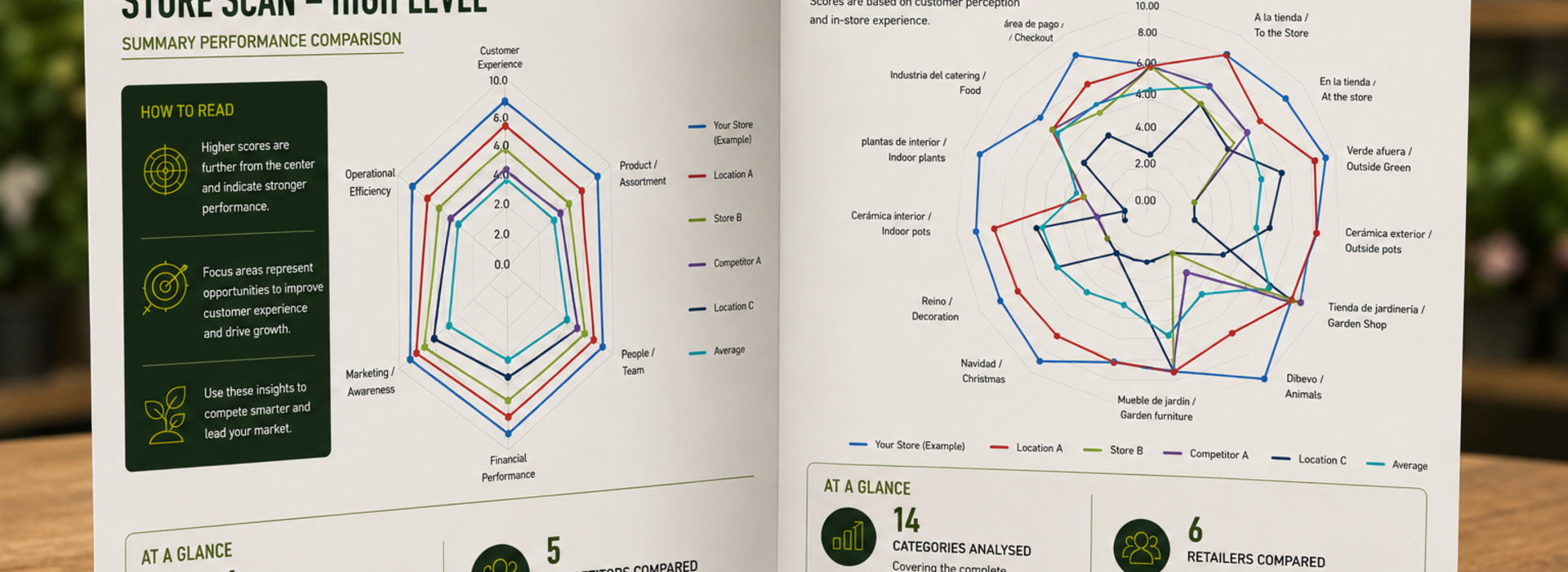
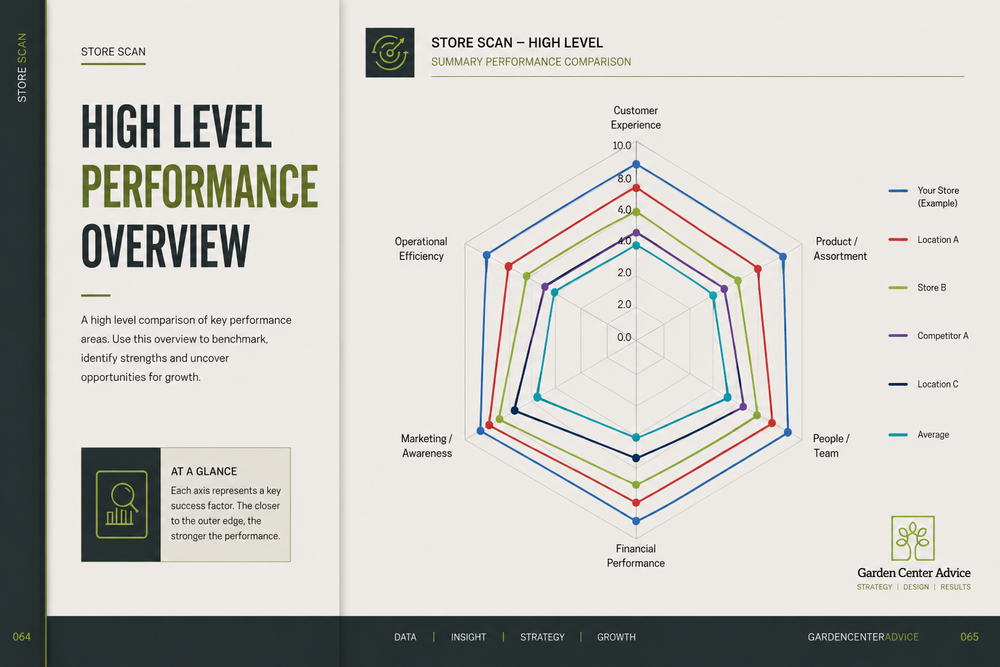
The first level compares six key performance areas across all scanned stores:
- Customer experience
- Product and assortment
- People and team
- Financial performance
- Marketing and awareness
- Operational efficiency
Plotted together, these six axes give you the shape of your business at a glance. The further a line sits from the centre, the stronger the performance. Where your line pulls in while a competitor's pushes out, you are looking at a gap that is costing you customers.
This view is deliberately simple, because its job is to settle the big question first: are we ahead, level, or behind, and in which direction should we be spending?
Assortment level: where exactly the gap sits
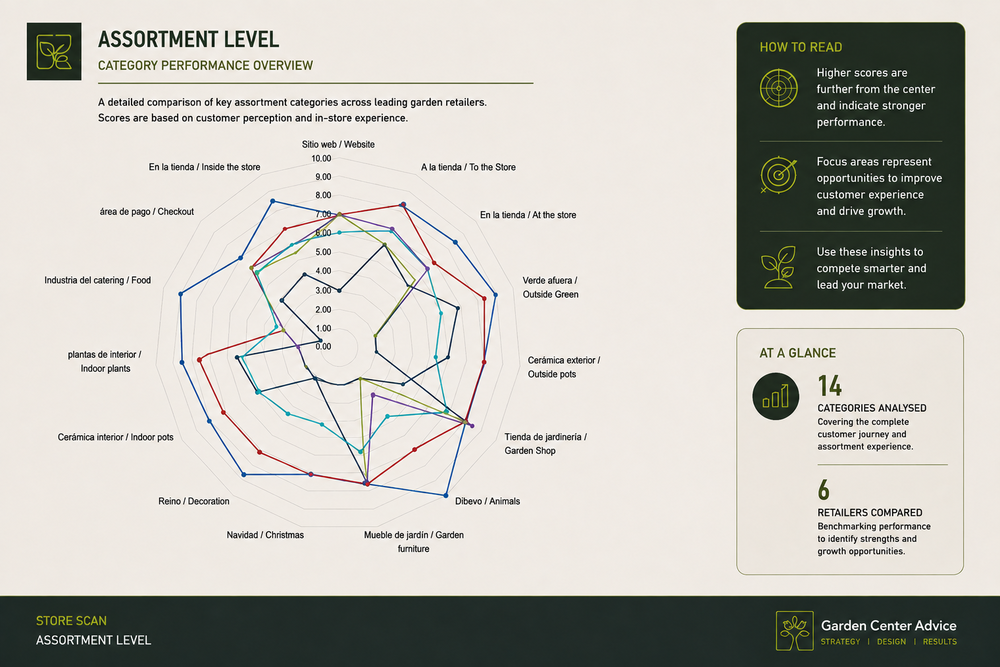
Knowing you are behind on assortment is useful. Knowing you are behind on outdoor pots, garden furniture and Christmas, while leading on indoor plants, is actionable.
The second level breaks the store down into fourteen categories covering the complete customer journey and the full assortment:
Website · Route to the store · Arrival at the store · Outdoor green · Outdoor pots · Garden shop · Animals · Garden furniture · Christmas · Decoration · Indoor pots · Indoor plants · Food and catering · Checkout area
Each category is scored on customer perception and in-store experience, then compared across the retailer set. This is where the overview turns into a work list. You can see precisely which categories carry your store, which ones are dragging it down, and which ones a competitor has taken ownership of in your area.
How we score
Scores are based on what a customer actually perceives and experiences, not on what the floor plan or the assortment list says should be there.
That distinction matters. A category can be fully stocked and still score poorly, because it is badly positioned, poorly presented, hard to find, or sitting next to something that undermines it. Customers do not shop a spreadsheet. They shop a space, and they form a judgement about your store within the first thirty seconds of walking in.
StoreScan captures that judgement and puts a number on it.
What you get
A StoreScan report contains:
- The high-level performance comparison across all six areas
- The full fourteen-category assortment comparison
- Your position against each individual benchmark store, and against the group average
- Identified strengths worth protecting and defending
- Identified focus areas, prioritised by the size of the gap and the size of the opportunity
The report is written to be used, not filed. It is the document you take into a management meeting, a supplier negotiation, or a refit conversation.
Why an outside party has to do it
You could score your own store. Most owners who try end up scoring their intentions rather than their reality, and they have no way to score the competition with the same rigour.
Garden Center Advice is independent. We do not sell shelving, plants, pots or fixtures, and we have no commercial interest in which conclusion the scan reaches. If your store is strong, the report says so. If a competitor has beaten you on a category, the report says that too. That independence is the entire reason the numbers are worth trusting.
Who it is for
StoreScan is built for garden centre owners and directors who want to make their next investment decision on evidence rather than instinct. It works particularly well:
- Before a refit or refurbishment, to decide where the budget should go
- When performance has flattened and the cause is not obvious
- When a new competitor has opened nearby
- Across a group of locations, to see which stores are underperforming and why
- As an annual measurement, to track whether changes actually moved the needle
Start with the scan
Most improvement projects fail because they begin with a solution instead of a diagnosis. StoreScan is the diagnosis. It is a fixed piece of work with a clear scope, a clear output, and a clear price, and it gives you the map before you commit to the route.
Want to know where your store really stands? Get in touch to arrange a StoreScan.
 podcast on
  Spotify