




The Dutch Blueprint Behind Dubai's Biggest Garden Centre
The Dutch Blueprint Behind Dubai's Biggest Garden Centre
How Acacia Garden Center turned a plant nursery in Al Warsan into a lifestyle destination — and what that says about the way the UAE gardens now.
Drive out along the Ras Al Khor corridor, past the warehouses and the truck depots, and you eventually reach Al Warsan 3 — a stretch of Dubai that the municipality set aside years ago for the trade in plants and garden supplies. It is not where you would expect to find a retail experiment. But it is where Acacia Garden Center has spent the better part of a decade quietly redefining what a garden centre in the Gulf is supposed to be.
The business opened around 2010, at a moment when Dubai's freehold property market was producing thousands of new villa owners for the first time. Those owners had gardens, balconies and terraces, and very little idea where to buy a decent olive tree or a pot that would survive August. Acacia's original proposition was simple and logistical: put everything a homeowner might need under one roof. Indoor and outdoor plants. Ceramic, fibreglass and fibre-clay planters. Soil, mulch, tools, furniture. Sixty-five thousand square feet of it.
That model worked well enough to make Acacia one of the largest garden centres in the country. What is more interesting is what happened next.
Studying the Dutch
In 2022, the management of Tanseeq Investment Group — Acacia's parent company — began making repeated trips to the Netherlands. The purpose was not procurement. Dutch garden centres, or tuincentra, are the most commercially sophisticated in the world, and the trips were essentially field research. The following step was to hire a Dutch garden centre designer to redraw the Al Warsan site from scratch.
It is worth understanding what the Dutch actually figured out, because it explains the whole exercise. In the Netherlands, garden centres long ago stopped being seasonal plant shops and became year-round retail destinations, complete with cafés, homeware, seasonal displays and events. The insight was that the plants themselves are low-margin, weather-dependent and difficult to hold in stock, while the reason people come for plants — the desire to make a home feel a particular way — is neither seasonal nor low-margin. Build for the reason, and the plants sell themselves.
Transplanting that idea to Dubai required inverting one variable. Dutch garden centres are busiest in spring and summer and rely on indoor space to survive the winter. Dubai's calendar runs the other way: the outdoor season opens in October and closes in April, and the summer is the dead zone. Acacia timed its refurbishment for the off-peak months and reopened just as the weather turned.
What the revamp added
The plant range stayed — an inventory sourced from the Netherlands, Thailand, Spain, Italy, Vietnam, India and China, which is itself a reminder that almost nothing in a Gulf garden is native to it. Around that core, the redesigned complex added the things that turn a purchase into an afternoon.
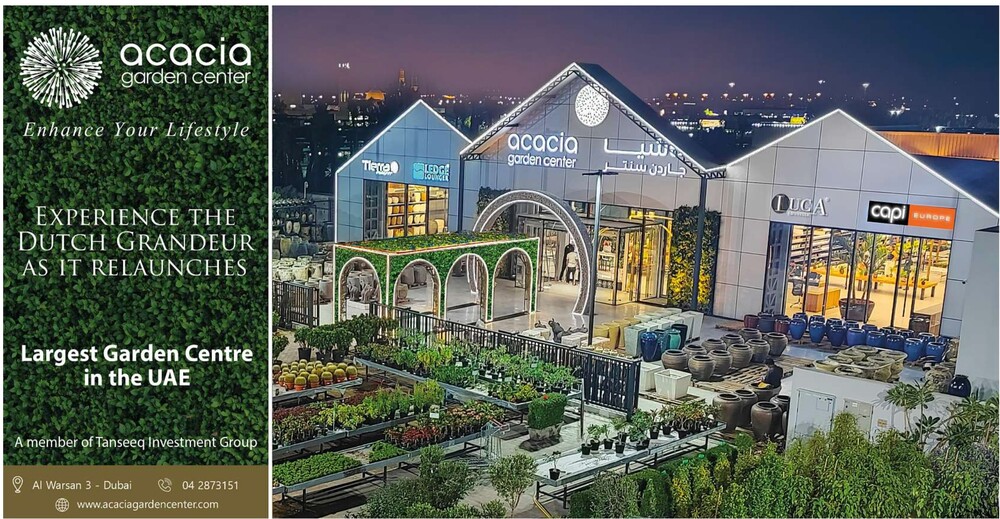
There is an expanded outdoor living offer: shade structures, water features, garden lighting, decking, and outdoor cooking — kamado-style ceramic grills now sit near the furniture displays, which tells you exactly which customer the centre is chasing. There is a flower shop and a gift shop. And there is a courtyard, built specifically to host workshops through the cooler months, where visitors can spend an hour on a craft project with materials supplied.
None of this is accidental. A workshop is a reason to visit a garden centre in the absence of any intention to buy a plant, and a visit is the thing the entire model depends on. The tagline the company uses — Enhance Your Lifestyle — is doing more work than a slogan usually does. It is an accurate description of the category the business moved into.
The broader shift
Acacia's transformation reflects something happening across the region's home and garden market. Outdoor space in the UAE has been reframed over the past decade: no longer a maintenance obligation to be handled by a contractor, but an extension of the living room, styled and photographed accordingly. Social media accelerated it. The pandemic entrenched it. Villa communities across Dubai and the Northern Emirates now treat the garden as a design project.
That shift favours retailers who can sell the whole picture rather than its components. A landscaping contractor sells a service. A nursery sells a plant. A garden centre in the Dutch mould sells the finished image — and then supplies every part of it, with same-day delivery and staff who can tell you why the ficus in your hallway keeps dropping leaves.
Whether the format scales in a market of Dubai's size is an open question. Garden centres in the Netherlands benefit from a dense population with a deep gardening culture and a mild climate that permits year-round planting; Dubai has extreme heat, a highly transient population and a housing stock skewed towards apartments. The addressable market for a 65,000-square-foot destination retailer is real but not unlimited, and the summer months remain a structural problem no amount of design solves.
Still, the direction of travel is clear enough. The centre that opened in Al Warsan to sell pots to new villa owners is now selling something considerably less tangible. The plants, at this point, are almost the least of it.
 podcast on
  Spotify